
Government Medical Officers’ Association (GMOA)
The Government Medical Officers’ Association (GMOA) stands as the premier professional and trade union body representing government medical officers in Sri Lanka, with a proud legacy spanning nearly a century of service, advocacy, and commitment to the nation’s health system.
1926
A Legacy Born in the Central Province
The GMOA was inaugurated on 16th October 1926 at a historic meeting held in Kandy, attended by sixteen pioneering medical officers. Initially established as the Government Medical Officers’ Association (Central Province), its activities were confined to the Central Province, though membership was open to medical officers across the country. From its inception, the Association sought not only to safeguard the rights, privileges, and welfare of medical officers, but also to foster unity and professional camaraderie among its members. The Association’s first President was Dr. H. Ludovici, supported by Joint Secretaries Dr. S. L. Navaratnam and Dr. I. A. Senanayake. Many of the issues raised at the inaugural meeting such as salaries, quarters, and travel allowances remain relevant today, underscoring the enduring role of the GMOA in advocating for its membership.
1927
Formative Years: From Provincial Roots to a National Identity
In September 1927, the Association expanded its vision and scope, adopting the name Government Medical Officers’ Association of Ceylon, marking its transition into a truly national body. Shortly thereafter, the first Annual Dinner was held on 10th December 1927, marking an important milestone in the Association’s early development. In the formative years, the GMOA seems to have functioned more as a Social Club, evidence of militancy being conspicuous by its absence. (The country was under British rule at Interviews with the Directorate seem to have been formal affairs, months ahead, with the Agenda carefully drawn up, a far cry from today. Letters to and from the Department were couched in suitably prim and proper language.
1936
Expansion of the Executive Committee
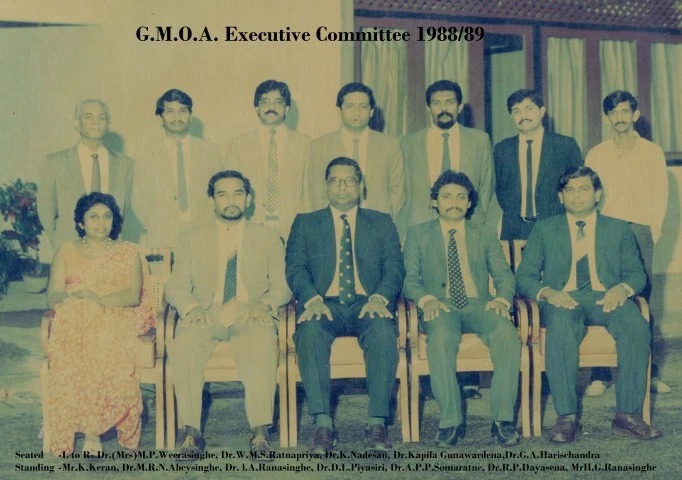
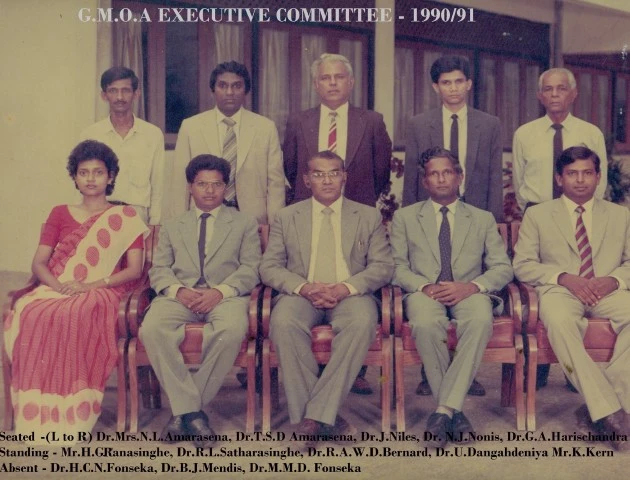
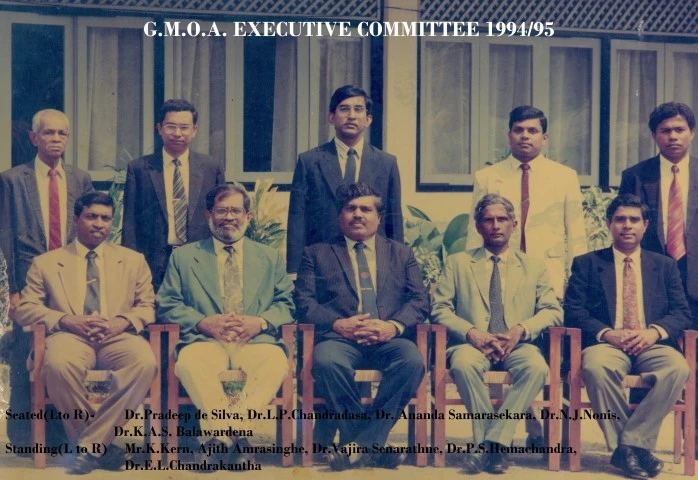
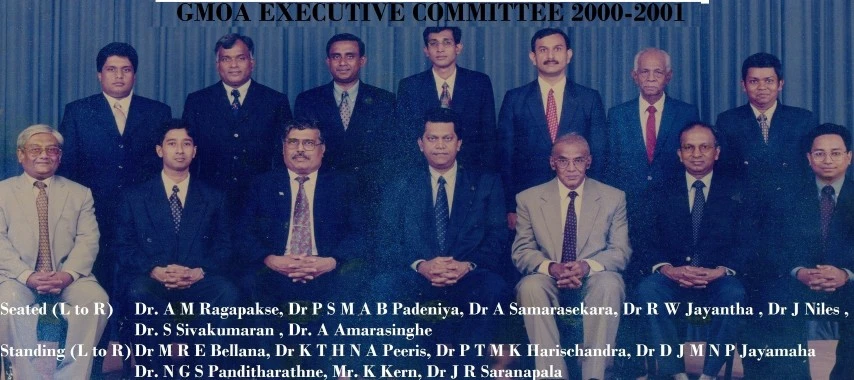
In 1936, the Executive Committee of the GMOA was expanded to meet the growing needs of the Association. This expansion included the appointment of three Secretaries, a structural framework that has largely endured over time. Today, despite a substantial increase in membership, the Association functions with six Assistant Secretaries, reflecting its expanded scope and responsibilities. During this period, several positions of ex-officio Vice Presidents were also established. These roles were held by Medical Superintendents, with Provincial Surgeons and Inspecting Medical Officers eligible for appointment, thereby strengthening administrative representation within the Association. In 1937, the GMOA made its first formal demand for the provision of paid ward facilities for doctors, a request that was ultimately granted in 1974, thirty-seven years later. This milestone underscores the Association’s sustained commitment to long-term advocacy. The Association appears to have gone into hibernation during the years 1939 to 1945, possibly due to the ban on activities during the war years.
1945
From Renewal to Recognition
In 1945, the GMOA embarked on a renewed phase of activity under the leadership of Dr. E. M. Wijerama, who served as President for three years. This period of revitalization culminated on 18th July 1949, when the Association was officially registered as a trade union under the Trade Unions Ordinance and assigned Registration Number 291, marking a defining milestone in its institutional evolution.
In 1956, under the presidency of Dr. Frank Fernando, the GMOA mounted its first major challenge to the government in pursuit of improved service conditions for medical officers. Following intense negotiations, the issue was resolved when the Prime Minister of the time, Mr. S. W. R. D. Bandaranaike, personally addressed a GMOA meeting to announce the introduction of a new allowance for all government medical officers.
From its inception, the GMOA has consistently worked to improve salaries, allowances, and conditions of service of government medical officers. Archival correspondence from the early years reveals representations made to the Director of Medical and Sanitary Services highlighting concerns regarding inadequate remuneration, housing difficulties, and stagnation in junior grades concerns that remain strikingly relevant today.
In parallel, the Association has remained steadfast in its commitment to protecting the rights and privileges of its members, a responsibility that has grown increasingly complex over time due to expanding political involvement within the health service, including the appointment of non-medical administrators. Despite these challenges, the GMOA continues to serve as a principled and resolute advocate for its membership.
1964
A Defining Moment in Trade Union Advocacy
The water-shed in trade union work was reached in 1964 when the membership of the day overwhelmingly voted for the institution-of trade union action to increase salaries. This was tile first time that doctors in any part of the world had struck work. The action was successful and the Government awarded an increase in salaries and limited form of practice (Channel Practice). Since then, the Association has resorted to trade union action as a last resort when negotiations have broken down and with lot of heart-searching as that ‘he interest of the patients are paramount in the minds of its members. We are glad to say that the need for such action has been used very sparingly considering the sometimes very obstinate stance taken by the administration.
The union has wielded the strike weapon both to win demands and to safeguard the position of an individual member, as the walkout staged by the Kandy doctors in support of one of its members, when he was attached by a member of the armed forces.
The GMOA has acted as a watchdog to prevent irregularities in appointments, transfers and the awarding of scholarships for further training, by the Administration. The GMOA has also played a mediatory role between the department and doctors who have fallen foul of the administration due to friction between officers serving in far flung posts and the local politicians.
The GMOA has taken a concerned interest in the furtherance of development of the administrative structure of the Health Services and in the provision of post-graduate training facilities for junior hospital doctors. The Union has not been successful in. obtaining representation in the PGIM under whose auspices all post-graduate medical training in this country now takes place. This is a matter of profound regret to the Association and the PGIM loses by not having healthy dialogue with the junior members whom it seeks to serve.
Carrying the Legacy Forward
Today the GMOA is a potent force, with a membership exceeding 23 000. The 126 branch unions function effectively, both. at a local level and coordinating with the centre. What has been achieved up to now has been due to the dedication of the GMOA’s past members. Now the mantle has fallen on to the next generation of junior doctors to rally around the GMOA banner and ensure that our union will go from strength to strength.
Standing Firm for Medical Education and Patient Safety
In the recent past, the GMOA played a decisive and principled role in the national discourse surrounding SAITM, advocating for uniform standards in medical education, the protection of patient safety, and the preservation of the integrity of Sri Lanka’s state funded medical training system. This struggle reaffirmed the GMOA’s commitment to safeguarding the future of healthcare delivery in Sri Lanka.
Leadership During the COVID-19 Pandemic
The COVID-19 pandemic marked one of the most challenging periods in Sri Lanka’s public health history. During this unprecedented crisis, the GMOA assumed a leadership role in strengthening the national health sector response. The Association actively advocated for scientific and evidence-based interventions, mobilization of human and physical resources, protection of healthcare workers, and prioritization of vulnerable populations.
Recognizing the importance of public trust and awareness, the GMOA contributed to public education efforts, supported the dissemination of accurate information, and emphasized the need to counter misinformation. The Association also made timely recommendations to policymakers, collaborated with multiple stakeholders, and supported innovations aimed at improving pandemic preparedness, service delivery, and vaccination strategies. Throughout the pandemic, the GMOA stood firmly in support of frontline healthcare workers, ensuring their welfare while maintaining uninterrupted care for the public.
Service Beyond the Hospital: Disaster Response and Social Responsibility in Cyclone ‘Ditwah, Natural Disaster
The GMOA’s role extends beyond professional advocacy into humanitarian service and national responsibility. During the recent Cyclone Dithwa disaster, the Association mobilized swiftly and compassionately, coordinating donations, visiting affected hospitals, and organizing health camps across the country to ensure uninterrupted medical care for displaced and vulnerable communities.
These efforts reflect the GMOA’s enduring belief that medical professionals bear a collective responsibility to serve the nation in times of crisis, beyond institutional and occupational boundaries.